
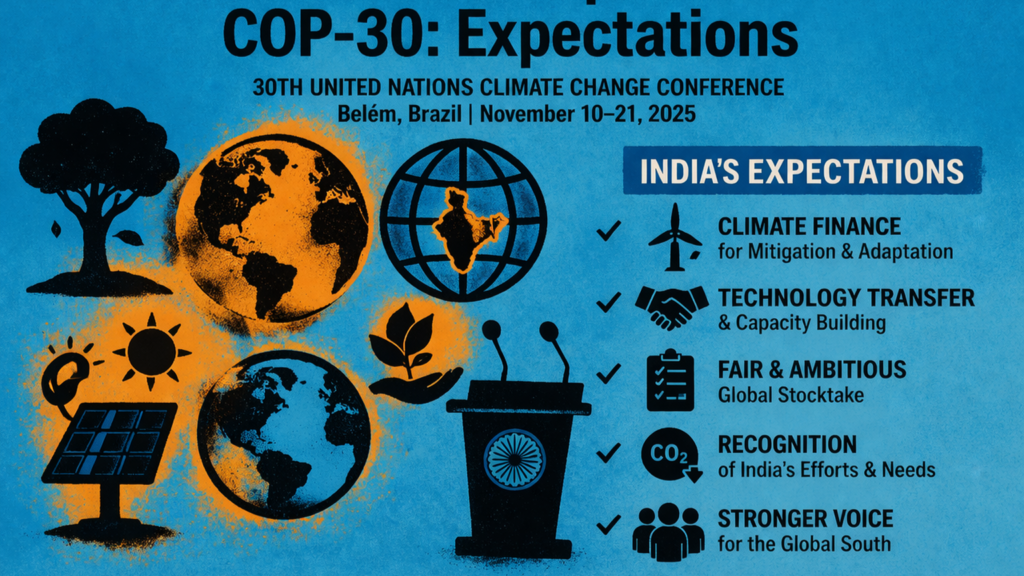
As the Conference of Parties to the UN Framework Convention on Climate Change prepares for its 30th session, India’s role as a major developing economy and climate-vulnerable nation positions it as crucial voice in global climate negotiations. Understanding India’s priorities and expectations provides insight into climate governance’s future trajectory.
India faces severe climate change impacts. Rising temperatures affect agriculture and livelihoods of millions. Erratic monsoons disrupt water security and farming cycles. Coastal regions face increased cyclone intensity and sea-level rise threats. Himalayan glacier melting threatens water supplies for major river systems. Additionally, heat waves cause mortality and productivity losses affecting vulnerable populations.
India’s Climate Commitments
India has made significant national pledges. Panchamrit announced at COP-26 includes reaching 500 GW non-fossil energy capacity by 2030, meeting 50% energy requirements from renewable sources, reducing emission intensity by 45% from 2005 levels, and achieving net-zero emissions by 2070. These commitments represent ambitious targets for a developing economy.
Key Expectations from COP-30
India will likely emphasize several priorities at the conference. Climate finance delivery on the USD 100 billion annual commitment from developed countries remains unfulfilled, undermining trust. India will push for substantially increased finance particularly for adaptation and loss and damage. Technology transfer enabling developing countries to access clean technologies at affordable costs is essential. Common but differentiated responsibilities principle must be upheld recognizing historical emissions and development imperatives. Additionally, adaptation funding parity with mitigation addressing immediate climate impacts is crucial.
Just Transition
India will advocate for equitable transition pathways. Developing countries require different timelines than developed nations for emission reductions. Energy access for millions living in poverty cannot be compromised. Coal-dependent communities need alternative livelihood support. Technology and financial assistance must enable green growth without sacrificing development. Additionally, carbon budgets should reflect per capita emissions ensuring equity.
Renewable Energy Leadership
India’s renewable energy achievements provide negotiating strength. Solar capacity expansion demonstrates commitment to clean energy. International Solar Alliance showcases leadership in South-South cooperation. Green hydrogen mission represents future-oriented approach. However, India will argue that developed countries should do more given historical emissions and current per capita consumption patterns.
Loss and Damage
Operationalizing the Loss and Damage Fund established at COP-27 is critical priority. India will push for adequate capitalization beyond token contributions. Governance structure ensuring developing country representation must be established. Disbursement mechanisms should be accessible without excessive bureaucracy. Additionally, attribution science linking specific damages to climate change should not delay assistance.
Adaptation Finance
Adaptation receives insufficient attention compared to mitigation. India faces enormous adaptation needs including climate-resilient agriculture, water resource management, disaster preparedness infrastructure, coastal protection measures, and public health systems strengthening. Dedicated adaptation finance at scale is non-negotiable for countries like India facing immediate climate impacts.
Carbon Markets
Article 6 of Paris Agreement on carbon markets requires careful implementation. India will seek mechanisms ensuring environmental integrity without allowing developed countries to offset emissions rather than reduce them. Market mechanisms must benefit developing countries economically. Safeguards preventing greenwashing and ensuring additionality are essential. Additionally, voluntary carbon markets should complement rather than replace compliance mechanisms.
China Factor
As fellow major developing economy and BASIC group member, coordination with China presents opportunities and challenges. Joint positions on climate finance and differentiation strengthen negotiating power. However, different development stages and political considerations may create divergences. Balancing cooperation with maintaining independent positions reflecting India’s specific circumstances is delicate task.
Developed Country Accountability
India will emphasize developed countries’ responsibilities. Historical emissions accounting shows developed countries’ outsized contribution to climate crisis. Current per capita emissions remain far higher than India’s. Promised finance and technology transfer have not materialized adequately. Climate justice demands that those who caused problem lead in solving it while supporting affected countries.
Domestic Implementation
India’s international positions are backed by domestic actions. Renewable energy targets represent serious commitment. Energy efficiency initiatives reduce emission intensity. Forest cover maintenance and expansion sequester carbon. Electric vehicle promotion accelerates transport sector transition. Additionally, adaptation programs build climate resilience across sectors.
Challenges and Opportunities
COP-30 presents challenges and potential breakthroughs. Climate finance mobilization could accelerate if developed countries honor commitments. Technology partnerships could enable faster clean energy adoption. However, geopolitical tensions may hinder cooperation. Economic slowdowns could reduce ambition. Additionally, extreme weather events may create urgency but also strain resources.
Conclusion
India’s participation in COP-30 will balance advocating for developing country interests with demonstrating leadership through domestic action. Expectations center on climate justice, adequate finance, technology transfer, and equitable burden-sharing. Success requires bridging developed and developing country positions, translating commitments into implementation, and recognizing that climate action and development are not zero-sum choices but must proceed together. India’s voice at COP-30 will significantly shape global climate governance’s future direction.
References:
- Paris Agreement, 2015
- India’s Nationally Determined Contributions
- UNFCCC documents and COP decisions
National Action Plan on Climate Change