
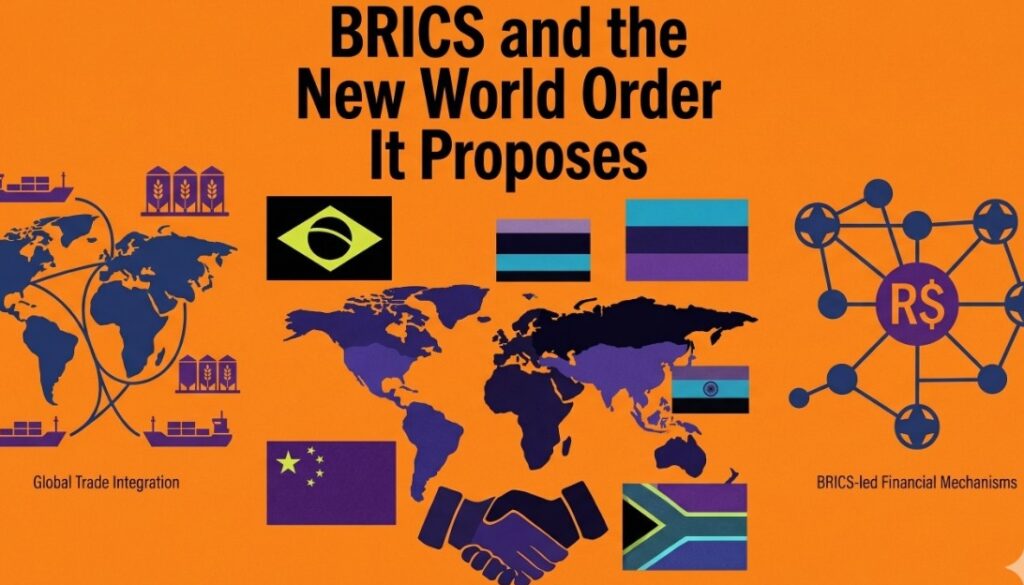
BRICS, comprising Brazil, Russia, India, China, and South Africa, has evolved from an economic grouping into a platform proposing alternative global governance structures. Understanding BRICS’ vision for international order reveals shifting power dynamics in multilateral institutions.
Originally coined as an investment term in 2001, BRIC formalized into a political grouping in 2009. South Africa joined in 2010, completing the current composition. Recent expansion in 2024 added several new members including Egypt, Ethiopia, Iran, Saudi Arabia, and the United Arab Emirates, significantly broadening the coalition’s scope and influence.
Core Principles
BRICS advocates several foundational principles for international relations. Multilateralism emphasizes collective decision-making over unilateral action by dominant powers. Respect for sovereignty and non-interference in internal affairs contrasts with interventionist approaches of some Western nations. South-South cooperation promotes development partnerships among emerging economies. Reform of global governance institutions seeks greater representation for developing countries. Additionally, multipolarity challenges Western-dominated international order.
Economic Dimensions
BRICS proposes alternative economic architectures. The New Development Bank (NDB) established in 2014 provides development financing as alternative to Western-dominated institutions. The Contingent Reserve Arrangement offers financial stability mechanism during currency crises. Promotion of local currency trade reduces dollar dependence in international transactions. Infrastructure financing through NDB supports connectivity projects across developing countries. Additionally, discussions about common currency explore reducing reliance on dominant currencies.
Governance Reform Agenda
BRICS advocates restructuring global institutions. United Nations Security Council reform seeks permanent representation for emerging economies. IMF and World Bank voting share redistribution demands recognition of emerging economies’ economic weight. WTO reform addresses perceived bias toward developed countries. Climate finance architecture changes ensure equitable burden-sharing. Additionally, digital governance frameworks protect sovereignty in cyberspace.
India’s Position
India’s approach to BRICS balances multiple interests. Support for multilateralism aligns with traditional non-alignment principles. Economic cooperation opportunities benefit India’s development priorities. Voice in global governance serves national interests. However, India maintains caution regarding proposals conflicting with strategic partnerships with Western nations. Additionally, border tensions with China complicate wholehearted embrace of all BRICS initiatives.
Challenges to BRICS Vision
Several factors limit BRICS effectiveness in reshaping world order. Internal divergences among members on key issues prevent unified positions. Economic disparities and different development models create conflicting interests. Geopolitical tensions particularly between India and China strain cooperation. Western institutions’ continued dominance limits alternative structures’ impact. Additionally, lack of binding commitments weakens collective action.
Recent Developments
Expansion to include new members demonstrates BRICS’ growing appeal among developing nations. Enhanced cooperation on payment systems reduces transaction costs and currency risks. Joint positions on climate change emphasize developed countries’ historical responsibility. Technology cooperation in areas like AI and space exploration pools resources. Additionally, cultural exchanges strengthen people-to-people connections.
Legal and Institutional Frameworks
BRICS cooperation increasingly formalizes through institutional mechanisms. Summit declarations articulate common positions on global issues. Working groups on various sectors coordinate policies. Framework agreements guide cooperation in specific areas. However, unlike EU or other regional organizations, BRICS maintains flexible, non-binding character preserving members’ sovereignty.
Implications for Global Order
BRICS’ rise reflects broader power shifts in international system. Emerging economies demand greater voice proportionate to economic weight. Alternative institutions provide options reducing dependency on Western-dominated frameworks. Multipolarity challenges unipolar moment following Cold War’s end. However, rather than replacing existing order, BRICS seeks reformation ensuring greater inclusivity.
The Path Ahead
BRICS’ future depends on balancing internal diversity with collective action, demonstrating concrete benefits to member states and broader developing world, and managing relationships with established powers and institutions. Whether BRICS fundamentally reshapes global order or merely adds another voice to existing frameworks remains to be seen.
References:
- BRICS Summit Declarations
- New Development Bank Charter
- Academic analyses of BRICS and global governance