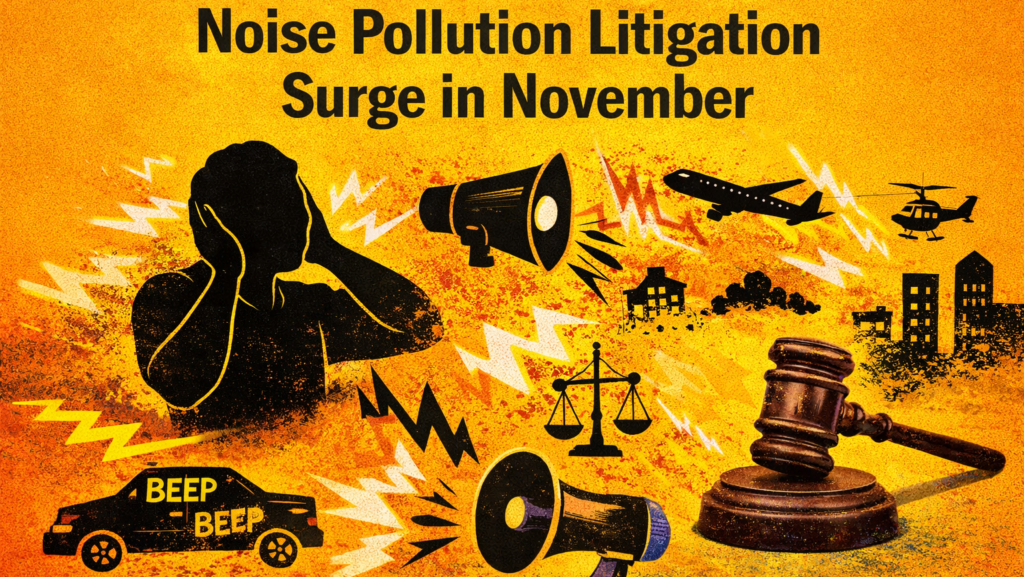
November typically witnesses increased litigation related to noise pollution, coinciding with festival season and wedding celebrations. This surge highlights growing public awareness about noise pollution’s health impacts and the need for effective regulatory enforcement.
Excessive noise causes significant health problems. Prolonged exposure leads to hearing impairment and potential permanent damage. Noise pollution disrupts sleep patterns affecting physical and mental health. Cardiovascular problems including hypertension and heart disease link to chronic noise exposure. Children’s learning and cognitive development suffer in noisy environments. Additionally, stress, anxiety, and reduced quality of life result from constant noise disturbance.
Legal Framework
Comprehensive regulations address noise pollution. The Noise Pollution (Regulation and Control) Rules, 2000 set permissible noise levels for different zones including residential, commercial, and industrial areas. The Environment (Protection) Act, 1986 provides overarching authority for noise regulation. Municipal laws grant local authorities powers to regulate noise-generating activities. The Police Act empowers police to take action against noise disturbances. Additionally, judicial precedents establish right to peaceful environment under Article 21.
November Litigation Trends
Recent months show increased noise-related cases. Petitions challenge excessive noise from wedding venues, particularly in residential areas. Complaints target religious places using loudspeakers beyond permitted hours and decibel levels. Cases address construction activities violating time restrictions and noise standards. Industrial units face litigation for exceeding permissible noise limits. Additionally, traffic noise from highways and commercial areas generates complaints.
Common Violations
Typical violations include use of loudspeakers without permission or beyond permitted times, particularly during religious and social events. Wedding and event venues exceed noise limits disturbing residential neighborhoods. Construction work occurs during prohibited night hours. Vehicle pressure horns and modified silencers create excessive noise. Additionally, commercial establishments operate outdoor music systems without authorization.
Judicial Response
Courts increasingly recognize noise pollution’s seriousness. Directions are issued mandating compliance with noise regulations and time restrictions. Penalties are imposed on violators including event organizers and religious institutions. Loudspeaker permissions are cancelled for repeated violations. Compensation is ordered in cases of prolonged disturbance affecting health. Additionally, monitoring committees are established to oversee compliance in problematic areas.
Enforcement Challenges
Effective implementation faces multiple obstacles. Limited personnel prevent round-the-clock monitoring across vast urban areas. Lack of noise monitoring equipment hinders objective measurement. Cultural sensitivities around religious activities complicate enforcement. Political pressure sometimes undermines action against violators. Additionally, weak penalties fail to deter wealthy violators for whom fines are negligible.
Technological Solutions
Modern tools can improve enforcement. Sound level meters enable objective measurement of noise levels. Mobile applications allow citizens to report violations with location data. Continuous monitoring systems in sensitive zones provide real-time data. Digital platforms for loudspeaker permissions streamline authorization processes. Additionally, automated number plate recognition can identify vehicles with illegal modifications.
Community Awareness
Public education plays crucial roles in noise reduction. Awareness campaigns highlight health impacts of noise pollution. Information about permissible noise levels and reporting mechanisms empowers citizens. Community-led initiatives promote quiet zones around hospitals and schools. Social pressure can encourage voluntary compliance beyond legal requirements. Additionally, celebrating festivals and events responsibly becomes cultural norm.
Balancing Rights
Regulations must balance multiple interests. Freedom of religion under Article 25 must be exercised respecting others’ rights. Cultural celebrations deserve accommodation within reasonable limits. Public health and peaceful environment constitute legitimate state interests. The principle of reasonableness guides courts in balancing competing rights.
Addressing noise pollution requires sustained effort combining legal enforcement, technological support, and social awareness to ensure citizens’ right to peaceful environment.
References:
- Noise Pollution (Regulation and Control) Rules, 2000
- Environment (Protection) Act, 1986
- Church of God (Full Gospel) in India v. KKR Majestic Colony Welfare Association, (2000) 7 SCC 282