
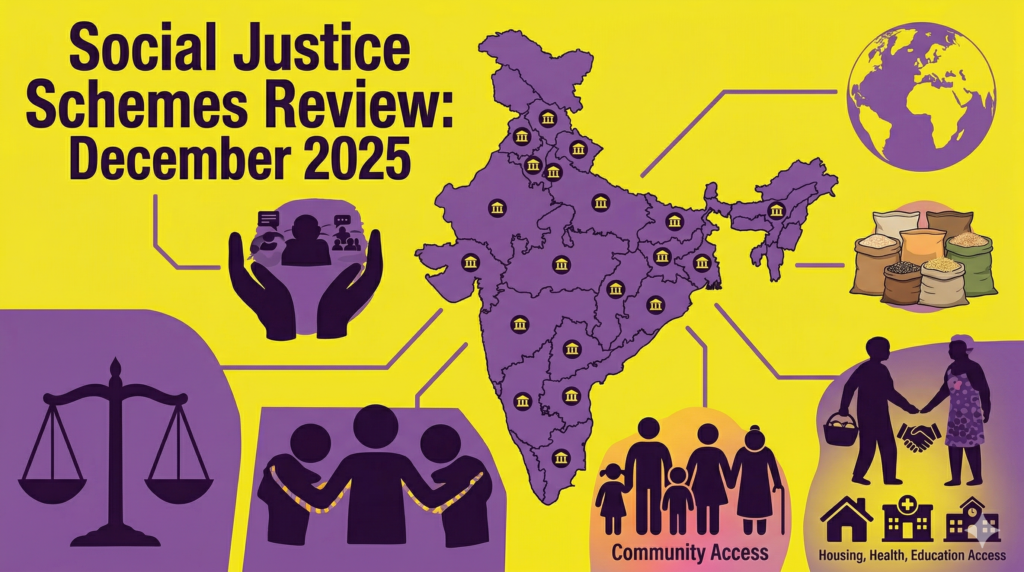
Social justice schemes aim at uplifting marginalized communities and ensuring inclusive development. Reviewing major initiatives’ performance provides insights into progress toward constitutional goals of equality and social justice.
The Constitution envisions socially just society through multiple provisions. Directive Principles under Articles 38, 39, and 46 direct the state to minimize inequalities and protect weaker sections. Article 15 permits special provisions for advancement of socially and educationally backward classes. Article 17 abolishes untouchability. Reservation provisions in Articles 15(4), 15(5), and 16(4) enable affirmative action. These provisions form foundation for social justice schemes.
Scheduled Castes Welfare
Major initiatives address historical disadvantages faced by Scheduled Castes. Pre-matric and post-matric scholarship schemes facilitate education access. Special Central Assistance provides state-specific interventions. National Scheduled Castes Finance and Development Corporation offers credit support for economic activities. Pradhan Mantri Adarsh Gram Yojana focuses on village development. However, fund utilization rates vary across states. Discrimination and social barriers persist despite legal protections.
Scheduled Tribes Development
Schemes targeting tribal communities address unique challenges. Eklavya Model Residential Schools provide quality education in tribal areas. Minimum Support Price for minor forest produce ensures fair compensation. Grants under Article 275(1) support state-specific tribal development. Van Dhan Vikas Kendras promote tribal entrepreneurship. However, implementation in remote areas faces infrastructure challenges. Land alienation and displacement issues require ongoing attention.
Other Backward Classes Initiatives
Welfare measures for OBCs focus on educational and economic advancement. Post-matric scholarships support higher education. National Backward Classes Finance and Development Corporation provides concessional loans. Skill development programs enhance employability. However, creamy layer identification and intra-OBC disparities require nuanced approaches. Additionally, ensuring benefits reach most disadvantaged within OBC category remains challenge.
Minority Welfare Schemes
Programs address socio-economic development of minority communities. Pre-matric and merit-cum-means scholarships promote education. Pradhan Mantri Jan Vikas Karyakram develops minority concentration areas. Nai Manzil scheme provides education to school dropouts. Seekho aur Kamao provides skill training. However, identification of beneficiaries and targeting effectiveness require improvement. Regional variations in minority community development need addressing.
Women’s Empowerment
Schemes promoting gender equality span multiple dimensions. Beti Bachao Beti Padhao addresses sex ratio and girls’ education. Pradhan Mantri Matru Vandana Yojana provides maternity benefits. Support to Training and Employment Programme for Women enhances employability. Working Women Hostels facilitate safe accommodation. However, deep-rooted patriarchal attitudes limit scheme effectiveness. Safety concerns and work-life balance issues need comprehensive addressing.
Persons with Disabilities
The Rights of Persons with Disabilities Act, 2016 guides welfare initiatives. ADIP Scheme provides assistive devices. National Fellowship supports higher education. Accessible India Campaign promotes universal accessibility. DDRS scheme assists states in disability welfare. However, accessibility infrastructure remains inadequate. Attitudinal barriers and employment discrimination persist. Additionally, implementation monitoring requires strengthening.
Senior Citizens
Ageing population necessitates focused attention on senior citizens. Integrated Programme for Senior Citizens supports states in elderly care. National Programme for Healthcare of Elderly provides specialized services. Pradhan Mantri Vaya Vandana Yojana offers pension products. However, inadequate old-age homes and healthcare facilities create gaps. Social isolation and elder abuse require comprehensive addressing.
Implementation Challenges
Common obstacles affect multiple schemes. Bureaucratic delays hinder benefit delivery. Lack of awareness among intended beneficiaries reduces uptake. Corruption and leakage divert resources. Inadequate monitoring enables implementation gaps. Coordination between multiple implementing agencies proves complex. Additionally, last-mile connectivity particularly in rural and remote areas remains weak.
Direct Benefit Transfer
DBT implementation has improved scheme efficiency. Direct bank account transfer reduces intermediaries and corruption. Aadhaar linking ensures authentic beneficiary identification. However, exclusion errors due to authentication failures create hardship. Digital divide affects vulnerable populations’ access. Technical glitches occasionally disrupt benefit delivery.
Way Forward
Strengthening social justice schemes requires multifaceted approach. Enhanced budgetary allocation ensuring adequate resources is essential. Improved targeting through socio-economic surveys identifies genuine beneficiaries. Simplified procedures reduce bureaucratic barriers. Technology leverage improves transparency and monitoring. Convergence across schemes maximizes impact. Additionally, regular evaluation and course correction based on outcomes improves effectiveness.
Social justice schemes represent India’s commitment to inclusive development. Continuous improvement in design and implementation will better realize constitutional vision of equitable society.
References:
- Constitution of India, Articles 15, 16, 17, 38, 39, 46
- Rights of Persons with Disabilities Act, 2016
- Ministry of Social Justice and Empowerment reports