
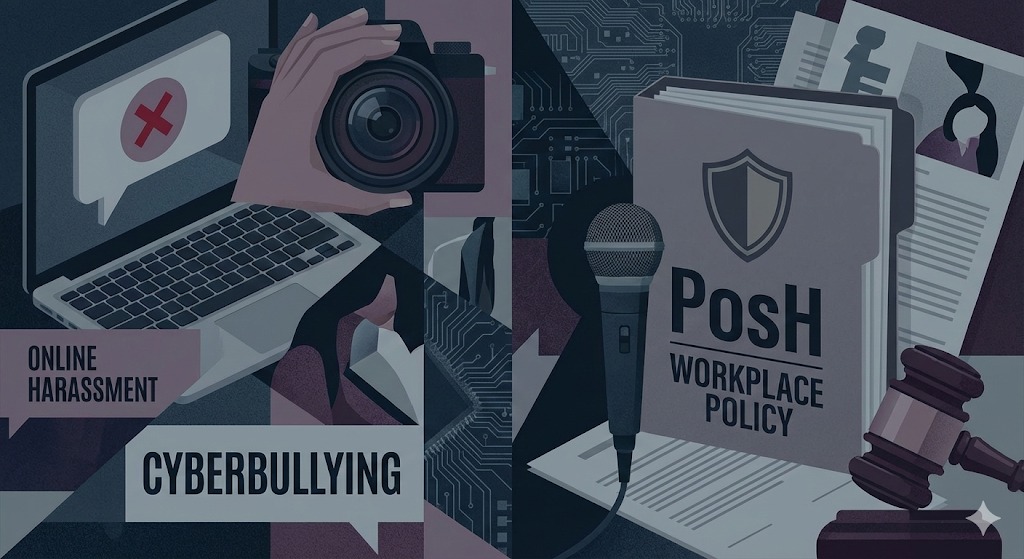
The Sexual Harassment of Women at Workplace (Prevention, Prohibition and Redressal) Act, 2013, commonly known as the POSH Act, was enacted to create safe working environments for women. However, the rise of remote work and digital communication has introduced new challenges that require legal and organizational attention. After the COVID 19 pandemic when the workplace globally moved to a virtual space, the incidents of online harassments surged. The Act, attempts to define “workplace” in a broad sense but initially the concept of “digital workspace” used to fall in a grey area. However, recently the Hon’ble Delhi High Court, emphasized on a forward looking definition to expand the scope of the Act.
The Digital Workplace Reality
Online harassment manifests through emails, video calls, messaging platforms, and social media interactions. Unwelcome comments during virtual meetings, inappropriate messages on workplace communication tools, or sharing of objectionable content in professional groups all constitute harassment under POSH provisions. Such incidents are not only traumatizing for the victim but is a reflection of the anti-social mindset which makes women feel “unsafe” in their homes.
Legal Framework and Applicability
The POSH Act applies to all organizations with ten or more employees. Internal Complaints Committees (ICCs) must investigate complaints regardless of whether harassment occurred physically or digitally. The Supreme Court’s Vishaka Guidelines, which form the foundation of POSH, emphasize creating a harassment-free environment, a principle that should naturally extend to digital platforms to keep up with the changing needs of the society. While the Act provides for a robust redressal mechanism for the victims, the organizations should proactively focus on preventing such incidents and provide such an environment which is safe for all the employees.
Implementation Challenges
Organizations face difficulties in monitoring online interactions without infringing on privacy rights. Determining jurisdiction becomes complex when employees work from different locations. Additionally, preserving digital evidence requires specific protocols that many companies have not yet established. Additionally, the introduction of AI, creation of deep fakes with it, along with creation of false chats, accounts make things difficult for the organization while dealing with such circumstances.
Moving Forward
Companies must update their POSH policies to explicitly address online harassment. Training programs should include scenarios relevant to digital workplaces. Clear guidelines on professional conduct in virtual settings, robust complaint mechanisms accessible remotely, and awareness about digital evidence preservation are essential steps. Regular sensitization, workshops and other such activities which foster a healthy organizational conduct among the employees should be prioritized rather than being considered as a mere “compliance”.
As work continues to evolve digitally, the legal framework must remain adaptive while maintaining its core objective: ensuring dignity and safety for all employees, regardless of where they work.
References:
- The Sexual Harassment of Women at Workplace (Prevention, Prohibition and Redressal) Act, 2013
- Vishaka v. State of Rajasthan, AIR 1997 SC 3011