
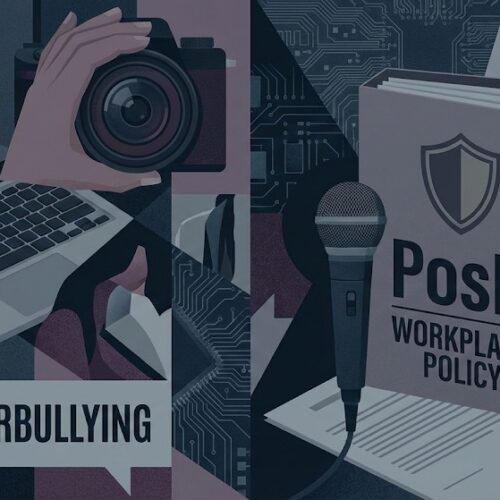
Online Harassment and POSH: Bridging the Digital Gap

  The Sexual Harassment of Women at Workplace (Prevention, Prohibition and Redressal) Act, 2013, commonly known as the POSH Act, was enacted to create safe working environments for women. However, the rise of remote work and digital communication has introduced new challenges that require legal and organizational attention. After the COVID 19 pandemic when the […]

Online Harassment and POSH: Bridging the Digital Gap Read More »

A woman with digital code projections on her face, representing technology and future concepts.

The Rise of Deepfake Crimes: Emerging Penal Framework

The rapid evolution of artificial intelligence has reshaped digital expression, but it has also opened the door to an alarming new frontier of criminality: deepfake crimes. By mid-2025, India witnessed a sharp uptick in cases involving AI-generated impersonations, manipulated videos, and synthetic audio that blur the lines between truth and fabrication. While technology has always

The Rise of Deepfake Crimes: Emerging Penal Framework Read More »

Vibrant Indian flag featuring the Ashoka Chakra, symbolizing patriotism and national pride.

Fundamental Duties under the Indian Constitution

The idea of Fundamental Duties in India traces its origin to the Soviet Constitution, from which our constitutional framers drew inspiration for creating a civic-responsibility framework. While the Constituent Assembly did not initially include duties, the debate around embedding citizen obligations gained prominence in later decades as India grappled with internal challenges to democratic discipline.

Fundamental Duties under the Indian Constitution Read More »

A monochrome image of a historical statue in Amritsar, Punjab, highlighting cultural heritage.

The Debates Around Uniform Civil Code Implementation

The conversation on the Uniform Civil Code (UCC) has resurfaced with a new intensity in recent years, reflecting India’s evolving social landscape. At its core, the UCC is not merely a legal reform it is a constitutional aspiration. Article 44 of the Directive Principles ( Part IV of the Indian Constitution) explicitly urges the State

The Debates Around Uniform Civil Code Implementation Read More »

Rainbow pride flags and symbols arranged on a rustic wooden table, representing LGBTQ+ pride and unity.

LGBTQIA+ Rights Post–Same-Sex Marriage Verdicts: A Progressive Analysis of Supriyo v. Union of India, (2023)

The Supreme Court’s Constitution Bench judgment in Supriyo @ Supriya Chakraborty v. Union of India, 2023 INSC 920 (17 October 2023), marks one of the most significant developments in India’s LGBTQIA+ rights discourse. Although the Court declined to legally recognise same-sex marriages or civil unions, the verdict offers a progressive, rights-affirming analysis of equality, dignity,

LGBTQIA+ Rights Post–Same-Sex Marriage Verdicts: A Progressive Analysis of Supriyo v. Union of India, (2023) Read More »

Corporate Accountability for Environmental Harm: Strengthening India’s Legal Framework

Environmental harm caused by corporate activities is no longer an abstract concern, it is a lived reality for countless communities across India. From polluted rivers to toxic emissions and groundwater contamination, the footprints of unchecked industrial growth are visible everywhere. In this context, corporate accountability has emerged as a crucial pillar of environmental governance, demanding

Corporate Accountability for Environmental Harm: Strengthening India’s Legal Framework Read More »

Understanding the Future of Legal Research: Why Lawyers Must Embrace Tech-Driven Learning

 The legal profession is evolving faster than ever. With courts increasingly digitalizing and legal research shifting to dynamic online platforms, lawyers today must move beyond traditional methods to stay relevant. At Aether Legal, we believe that the future of law belongs to those who combine strong doctrinal understanding with technological adaptability. Technology is not replacing

Understanding the Future of Legal Research: Why Lawyers Must Embrace Tech-Driven Learning Read More »