
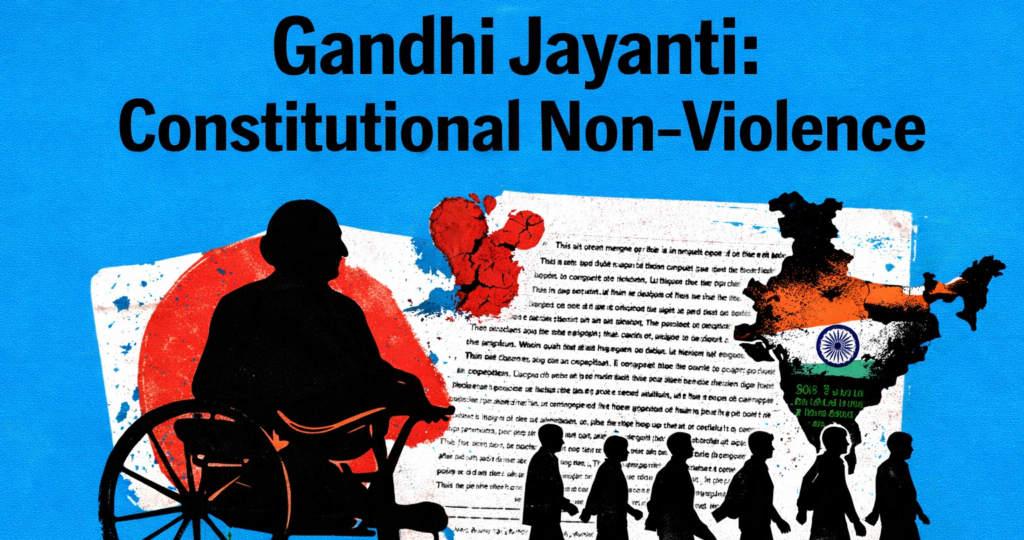
On Gandhi Jayanti, reflecting on the principle of non-violence within India’s constitutional framework reveals how Gandhian philosophy influenced the nation’s founding document and continues to shape legal and social discourse.
Mahatma Gandhi’s concept of ahimsa extended beyond mere absence of physical violence to encompass respect for all life, truthfulness in action and speech, and non-violent resistance to injustice. This philosophy guided India’s freedom struggle and profoundly influenced the Constituent Assembly’s deliberations.
Constitutional Foundations
While the Constitution does not explicitly mention non-violence, Gandhian principles permeate its provisions. The Preamble’s commitment to fraternity ensuring dignity of the individual reflects non-violent coexistence. Article 51’s directive to promote international peace and security echoes Gandhi’s vision of global harmony. Fundamental Duties under Article 51A include developing scientific temper, humanism, and the spirit of inquiry and reform, aligning with non-violent social transformation.
Several constitutional provisions embody non-violent principles. Article 19’s freedom of speech and expression enables peaceful dissent and dialogue. The right to peaceful assembly under Article 19(1)(b) provides constitutional protection to non-violent protest. Prohibition of discrimination under Articles 14 and 15 promotes social equality without violence. Additionally, protection of minority rights under Articles 29 and 30 ensures peaceful coexistence of diverse communities.
Judicial Interpretation
Courts have recognized non-violence as integral to constitutional democracy. Peaceful protest rights have been upheld as essential to democracy while violent demonstrations receive no protection. The balance between maintaining public order and respecting peaceful dissent reflects constitutional non-violence. Judgments emphasizing dialogue and mediation over punitive measures in certain contexts demonstrate this principle’s application.
Contemporary Relevance
In current social and political contexts, constitutional non-violence remains highly relevant. Peaceful resolution of conflicts through constitutional institutions and dialogue mechanisms is encouraged. Protection of dissent while preventing violence maintains democratic health. Restorative justice approaches emphasizing rehabilitation over retribution reflect non-violent principles. Additionally, environmental protection through sustainable rather than exploitative development embodies non-violence toward nature.
Challenges to Non-Violence
Several contemporary challenges test constitutional non-violence. Rising instances of mob violence and vigilantism undermine rule of law. Hate speech and communal tensions threaten peaceful coexistence. Political violence during elections corrupts democratic processes. Online harassment and cyberbullying represent new forms of violence requiring legal response.
Strengthening Non-Violent Values
Promoting constitutional non-violence requires civic education emphasizing peaceful conflict resolution and constitutional values, strengthening institutions that mediate disputes and protect rights, ensuring swift justice for violence while protecting peaceful dissent, and encouraging dialogue across social, political, and religious divides. Media responsibility in reporting conflicts without sensationalism is also crucial.
Gandhi’s vision of non-violence transcends individual morality to become collective constitutional commitment. Honouring this legacy requires constant vigilance and effort to build a society where dignity, peace, and justice prevail through non-violent means.
References:
- Constitution of India, Preamble and Articles 19, 51, 51A
- Gandhi’s writings on non-violence
- Supreme Court judgments on right to peaceful protest